Navigate Singapore's hyper-connected landscape in 2026 with an eSIM. This guide details the best NexaEsim plans, leverages networks like StarHub and Simba for reliable 4G/5G, and offers essential tips for tourists, digital nomads, and backpackers to ensure seamless connectivity from arrival to departure. Discover how to choose the ideal data package for your trip duration and usage needs.
For most tourists visiting Singapore in 2026, a NexaEsim plan offering 5-10GB of data over 5-7 days provides optimal balance for navigation, social media, and communication. NexaEsim leverages robust 4G/5G networks from Simba and StarHub, ensuring reliable connectivity across the city-state. Purchase your eSIM before arrival for instant activation and choose a plan tailored to your specific data needs and trip duration.
Singapore eSIM at a Glance: Key Takeaways
Ensuring seamless mobile data connectivity is paramount for a smooth travel experience in Singapore. Here are the essential points for your 2026 trip:
- eSIM Convenience: Digital eSIMs eliminate the need for physical SIM cards, allowing for easy pre-arrival purchase and instant activation upon landing.
- Reliable Networks: NexaEsim partners with leading local carriers like Simba and StarHub, offering extensive 4G and 5G coverage throughout Singapore.
- Tailored Plans: NexaEsim provides a range of data plans, from daily allowances (e.g., 500MB/day, 1GB/day) to total data packages (e.g., 3GB, 5GB, 10GB) and unlimited options, catering to light users, heavy users, and digital nomads.
- Optimal Travel Time: The dry season (February to April) offers the most pleasant weather and fewer crowds, ensuring optimal outdoor exploration and consistent network performance.
- Pre-Purchase Advantage: Buying your Esim Singapore in advance guarantees connectivity from the moment you arrive at Changi Airport, avoiding airport queues and potential overpricing.
Why an eSIM is Essential for Your 2026 Singapore Trip
Singapore, a global hub renowned for its technological advancement and efficient infrastructure, is an ideal destination for leveraging the power of eSIM technology. An eSIM, or embedded Subscriber Identity Module, is a digital SIM card that allows you to activate a cellular plan without needing a physical nano-SIM. This modern solution offers unparalleled flexibility and convenience for international travelers.
The primary advantage of an eSIM for your Singapore journey is its sheer efficiency. You can purchase and install your NexaEsim plan before you even depart, receiving a QR code via email for instant activation. This means no more searching for local SIM card kiosks at Changi Airport, avoiding potential language barriers or inflated tourist prices. Upon arrival, your device connects automatically, ensuring you're online from the moment you land.
Beyond convenience, eSIMs offer enhanced security, as there's no physical card to lose or have stolen. For travelers exploring beyond Singapore, many eSIM providers, including options on our global eSIM catalog, support multi-country plans, making regional travel across Southeast Asia seamless. This flexibility is particularly beneficial for backpackers and digital nomads who frequently switch destinations. Furthermore, eSIMs are compatible with most modern smartphones (iPhone XR and later, recent Android models), ensuring broad accessibility for a wide range of devices.
Understanding Singapore's Mobile Network Landscape
Singapore's telecommunications infrastructure is among the most advanced globally, offering robust 4G LTE and rapidly expanding 5G networks. Understanding the local carriers and how NexaEsim integrates with them is key to optimizing your connectivity.
Major Carriers: Singtel, StarHub, and M1
The Singaporean mobile market is primarily served by three major operators: Singtel, StarHub, and M1. Each offers extensive coverage and high-speed data services:
- Singtel: As the largest and oldest carrier, Singtel is generally recognized for having the most extensive and reliable network coverage nationwide, including more remote areas like Pulau Ubin. It often leads in speed and consistency, making it a preferred choice for business travelers or those requiring ultra-low latency.
- StarHub: A strong competitor, StarHub provides excellent coverage and competitive speeds, particularly within urban centers and major tourist areas. It's often a good value option, balancing performance with affordability.
- M1: While smaller than Singtel and StarHub, M1 offers reliable service in most tourist hotspots and urban areas. It can be a cost-effective choice for light to moderate users.
All three carriers have significantly invested in 5G technology, with Singtel and StarHub generally offering wider 5G availability across the island.
NexaEsim's Network Partners: Simba and StarHub
NexaEsim partners with Simba and StarHub to deliver reliable 4G and 5G connectivity across Singapore. This strategic partnership ensures that NexaEsim users benefit from robust network performance, especially in central business districts, popular tourist attractions, and residential areas. Simba, formerly TPG Telecom, has established itself as a competitive player, while StarHub is known for its strong urban performance. By leveraging these networks, NexaEsim provides a dependable connection for all your travel needs.
The default APN setting for NexaEsim in Singapore is mobile.three.com.hk, which is typically configured automatically upon eSIM activation. Should you encounter any connectivity issues, verifying this APN setting in your device's cellular data options can be a useful troubleshooting step.
4G and 5G Connectivity Across the City-State
Singapore's compact size and advanced infrastructure mean that 4G LTE coverage is virtually ubiquitous, delivering download speeds typically ranging from 50-200 Mbps. This is more than sufficient for everyday tasks such as navigation, social media, email, and standard-definition streaming.
For those requiring even faster speeds, 5G networks are widely available, particularly in key urban zones like Orchard Road, Marina Bay, and the Central Business District. On 5G, you can expect speeds up to 1 Gbps, which is ideal for high-definition video streaming, large file uploads, online gaming, and demanding remote work applications. While coverage in underground MRT sections or very remote natural parks might occasionally revert to 4G, overall connectivity remains strong across the island.
Choosing Your NexaEsim Singapore Plan: A Detailed Guide
Selecting the right eSIM plan is crucial for a stress-free trip. NexaEsim offers a diverse range of packages tailored for various durations and data consumption habits. All NexaEsim Singapore plans operate on the Simba and StarHub networks, providing reliable 4G and 5G connectivity without requiring eKYC (Know Your Customer) registration or offering a phone number. Top-ups are not listed for these plans, so choosing an appropriate initial data allowance is important.
NexaEsim Singapore Packages: Data, Validity, and Value
To help you decide, here's a comparison of some popular NexaEsim Singapore plans, verified from our catalog on 2026-10-06. Prices may change.
| Package Type | Data Allowance | Validity | Starting Retail Price (USD) | High-Speed Allowance / Throttled Speed | Best For |
|---|---|---|---|---|---|
| Daily Data | 500MB/day | 1-30 days | 0.52 (1-day) - 5.00 (30-day) | 500MB/day, then 128Kbps | Very light users, emergency data |
| Daily Data | 1GB/day | 1-30 days | 0.69 (1-day) - 6.38 (30-day) | 1GB/day, then 128Kbps | Light users, daily navigation & messaging |
| Daily Data | 2GB/day | 1-30 days | 0.86 (1-day) - 11.33 (30-day) | 2GB/day, then 128Kbps | Moderate users, social media & light streaming |
| Daily Data | 3GB/day | 1-30 days | 0.73 (1-day) - 13.53 (30-day) | 3GB/day, then 128Kbps | Active users, video calls & HD streaming |
| Daily Data | 100GB/day | 1-30 days | 2.20 (1-day) - 52.60 (30-day) | 100GB/day, then 1Mbps | Extremely heavy users, remote work, large downloads |
| Total Data | 3GB total | 3, 5, 7, 10, 15, 30 days | 1.12 (3-day) - 2.50 (30-day) | 3GB total, then 128Kbps | Short trips, light usage over several days |
| Total Data | 5GB total | 3, 5, 7, 10, 15, 30 days | 1.38 (3-day) - 2.76 (30-day) | 5GB total, then 128Kbps | Short to moderate trips, general usage |
| Total Data | 10GB total | 3, 5, 7, 10, 15, 30 days | 1.94 (3-day) - 3.14 (30-day) | 10GB total, then 128Kbps | Moderate to longer trips, active social media |
| Total Data | 20GB total | 3, 5, 7, 10, 15, 30 days | 3.88 (3-day) - 5.08 (30-day) | 20GB total, then 128Kbps | Longer trips, heavy streaming, light remote work |
| Total Data | 30GB total | 3, 5, 7, 10, 15, 30 days | 4.82 (3-day) - 6.76 (30-day) | 30GB total, then 128Kbps | Extended trips, moderate remote work, families |
| Total Data | 50GB total | 3, 5, 7, 10, 15, 30 days | 7.24 (3-day) - 10.17 (30-day) | 50GB total, then 128Kbps | Heavy users, extended stays, multiple devices |
| Unlimited Data | Unlimited (1GB/day) | 1-30 days | 1.46 (1-day) - 26.54 (30-day) | 1GB/day high-speed, then 10Mbps | Consistent daily usage, peace of mind |
| Unlimited Data | Unlimited (2GB/day) | 1-30 days | 1.21 (1-day) - 22.23 (30-day) | 2GB/day high-speed, then 5Mbps | Higher daily usage, moderate streaming |
For a comprehensive list and to purchase your ideal plan, visit the official Esim Singapore product page.
Tailoring Your Plan to Your Travel Style
Your ideal NexaEsim plan will depend heavily on your individual data consumption habits and the length of your stay:
- Light Users (3-5 days): If your trip is short and your data needs are minimal (maps, messaging, occasional social media), a 3GB or 5GB total data plan, or a 500MB/day or 1GB/day daily plan, will be sufficient. For a 5-day trip, consider the best unlimited eSIM picks for a 5-day Singapore trip.
- Moderate Users (7-10 days): For longer trips involving more active social media, streaming music, and frequent photo uploads, a 10GB total data plan or a 2GB/day daily plan is recommended. For a one-week trip, explore options for a simplest unlimited eSIM plan for a one-week Singapore trip. If you're planning a 10-day trip, consider choosing an unlimited eSIM for a 10-day Singapore trip.
- Heavy Users & Digital Nomads (15-30 days+): If you rely on constant connectivity for video calls, HD streaming, remote work, or managing multiple devices, an unlimited data plan (with its daily high-speed allowance) or a large total data package (20GB, 30GB, or 50GB) is essential. For a two-week trip, our guide on how to pick an unlimited eSIM for a two-week Singapore trip offers specific recommendations. If your travel extends to a full month, you'll want to read how to pick an unlimited eSIM for a 30-day Singapore trip.
Always monitor your data usage through your device settings to avoid unexpected throttling, especially with daily allowance plans. While NexaEsim plans do not offer top-ups, you can always purchase a new eSIM if your data runs out.
Seamless Activation: How to Buy and Install Your Singapore eSIM
One of the greatest advantages of using an eSIM is the straightforward purchasing and activation process. NexaEsim streamlines this to ensure you're connected without delay.
Pre-Arrival Purchase and Instant Delivery
The most efficient way to secure your connectivity is to buy an eSIM for Singapore travel with instant QR and 4G/5G plans before you even leave home. Browse the various NexaEsim plans on our website, compare the data allowances and validity periods, and select the one that best fits your trip. Once purchased, you'll receive an email containing a QR code. This digital delivery means no waiting for physical shipments and no last-minute scrambling at the airport, where prices can often be higher.
Step-by-Step Installation Guide
Installing your NexaEsim is a simple process:
- Ensure Device Compatibility: Confirm your smartphone is eSIM-compatible and unlocked. Most iPhones (XR and later) and recent Android models support eSIMs.
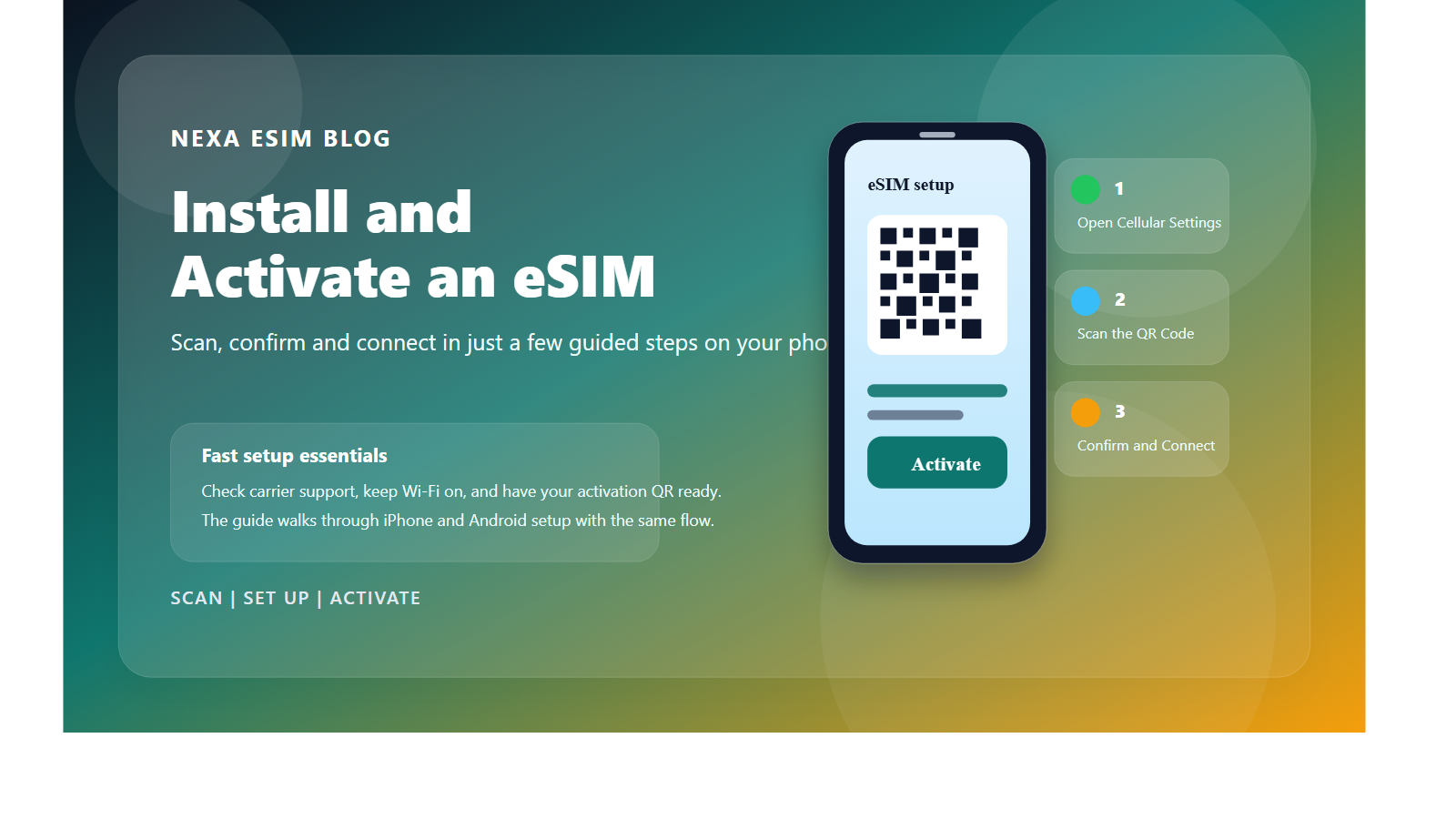
- Scan QR Code: Go to your phone's settings, navigate to "Cellular" or "Mobile Data," and select "Add Cellular Plan" or "Add Data Plan." Use your phone's camera to scan the QR code provided in your NexaEsim purchase email.
- Follow On-Screen Prompts: Your device will guide you through the remaining steps, which typically involve labeling your new eSIM (e.g., "Singapore Travel") and setting it as your primary data line.
- Enable Data Roaming (if necessary): While eSIMs often configure automatically, ensure data roaming is enabled in your cellular settings once you arrive in Singapore. This allows your eSIM to connect to the local Simba or StarHub networks.
For more detailed instructions and visual aids, refer to our comprehensive eSIM installation guide.
Troubleshooting Common eSIM Issues
While eSIMs are generally reliable, occasional issues can arise. Here are quick troubleshooting tips:
- No Service: Check if your device is unlocked and eSIM-compatible. Ensure "Data Roaming" is enabled for your eSIM profile.
- Slow Speeds: Verify that you are in an area with good 4G/5G coverage. If you're on an unlimited plan, check if you've exceeded your daily high-speed allowance, as speeds may be throttled.
- APN Settings: Although typically automatic, manually check the APN setting. For NexaEsim in Singapore, the APN is
mobile.three.com.hk. You can find this under your cellular settings for the eSIM profile. - Restart Device: A simple restart can often resolve minor connectivity glitches.
Maximizing Connectivity: Tips for Your Singapore Journey
Beyond choosing the right eSIM, a few practical tips can enhance your connectivity experience throughout your Singapore adventure.
Data Conservation Strategies
To make the most of your NexaEsim data plan:
- Utilize Wi-Fi: Connect to free Wi-Fi networks available in hotels, cafes, shopping malls, and public transport hubs (e.g., Changi Airport's free Wi-Fi) to conserve your cellular data for when you truly need it outdoors.
- Download Offline Maps: Before venturing out, download offline maps of Singapore using Google Maps or other navigation apps. This reduces data usage for navigation.
- Adjust Streaming Quality: If streaming video or music, opt for standard definition rather than high definition to significantly reduce data consumption.
- Disable Background App Refresh: Turn off background data usage for non-essential apps in your phone settings.
Optimal Travel Seasons and Weather Considerations
Singapore experiences a tropical climate, meaning it's warm and humid year-round with frequent rainfall. However, some periods are more favorable for travel:
- Dry Season (February to April): This period offers less rainfall and slightly milder temperatures, making it ideal for outdoor activities and minimizing any potential weather-related impact on network performance. Fewer crowds are also a bonus.
- Wet Season (November to January): Expect frequent, heavy showers. While urban network coverage remains generally stable, heavy rain can occasionally affect signal strength in more remote or exposed areas.
Regardless of the season, Singapore's robust networks ensure consistent service. However, planning your itinerary to include indoor attractions during potential rainy periods can enhance your overall experience.
Key Attractions and Their Connectivity Needs
Singapore's iconic attractions are well-covered by major networks, ensuring your NexaEsim performs reliably:
- Marina Bay Sands & Gardens by the Bay: These architectural marvels offer stunning photo opportunities. Your eSIM ensures instant uploads and seamless navigation through the vast Gardens by the Bay, even with its own Wi-Fi.
- Chinatown & Little India: Explore cultural enclaves where mobile data assists with translation apps, finding hidden eateries, and sharing vibrant street scenes.
- Sentosa Island: Home to Universal Studios and other family attractions, an eSIM allows for on-the-go ticket booking and real-time updates on show schedules.
- Singapore Zoo & Night Safari: Connectivity is invaluable for accessing digital maps, checking feeding times, and staying connected with your group.
From the moment you arrive at the stunning Changi Airport Jewel, your NexaEsim will keep you connected, ready to explore.
Frequently Asked Questions
What is the best eSIM for Singapore travel?
The best eSIM for Singapore travel is a NexaEsim plan tailored to your specific data needs and trip duration, leveraging the reliable 4G/5G networks of Simba and StarHub. For most tourists, a plan offering 5-10GB over 5-7 days provides excellent value and coverage.
Can I buy an eSIM for Singapore as a tourist?
Yes, tourists can easily purchase a NexaEsim for Singapore online before or during their trip. Ensure your phone is eSIM-compatible and unlocked. This eliminates the need for physical SIM swaps and provides instant connectivity.
Are there unlimited data eSIMs for Singapore travel?
Yes, NexaEsim offers unlimited data eSIM plans for Singapore. These typically come with a daily high-speed allowance (e.g., 1GB or 2GB per day), after which speeds are reduced to a still-usable rate (e.g., 10Mbps or 5Mbps). These are ideal for heavy users or digital nomads.
How do I install an eSIM for Singapore?
Installation involves scanning a QR code provided by NexaEsim via email. Go to your phone's cellular settings, select "Add Cellular Plan," and scan the QR code. Follow the on-screen prompts, and ensure data roaming is enabled upon arrival. For detailed steps, refer to our eSIM installation guide.
Is 5G available with eSIMs in Singapore?
Yes, NexaEsim plans in Singapore support 5G connectivity through its network partners, Simba and StarHub. To utilize 5G, ensure your device is 5G-capable and that you are in an area with 5G coverage.
What is a cheap eSIM for Singapore travel?
A cheap eSIM for Singapore travel from NexaEsim would typically be a daily data plan (e.g., 500MB/day or 1GB/day) or a smaller total data package (e.g., 3GB or 5GB total) for shorter trips. These plans offer essential connectivity at a budget-friendly price point.
Can I use an eSIM for backpacking in Singapore?
Absolutely. eSIMs are ideal for backpackers due to their convenience, flexibility, and cost-effectiveness. NexaEsim offers various plans suitable for backpacking, including options for longer durations or multi-country travel if you explore beyond Singapore via our multi-country catalog.
Conclusion: Your Connected Singapore Adventure Awaits
Navigating Singapore in 2026 with a reliable mobile data connection is not just convenient—it's transformative. An eSIM from NexaEsim provides the seamless, high-speed 4G/5G connectivity you need to explore this vibrant city-state, whether you're a casual tourist, a busy digital nomad, or a budget-conscious backpacker. By understanding the local network landscape, choosing a data plan tailored to your specific needs, and following our practical tips, you can ensure uninterrupted access to maps, social media, communication, and essential travel information.
The most important decision criterion is selecting a plan that matches your expected data usage and trip duration. With NexaEsim's diverse offerings on the robust Simba and StarHub networks, you're well-equipped for a connected journey.
Ready to experience Singapore without connectivity worries? Explore NexaEsim's range of Esim Singapore plans today and secure your seamless travel experience.