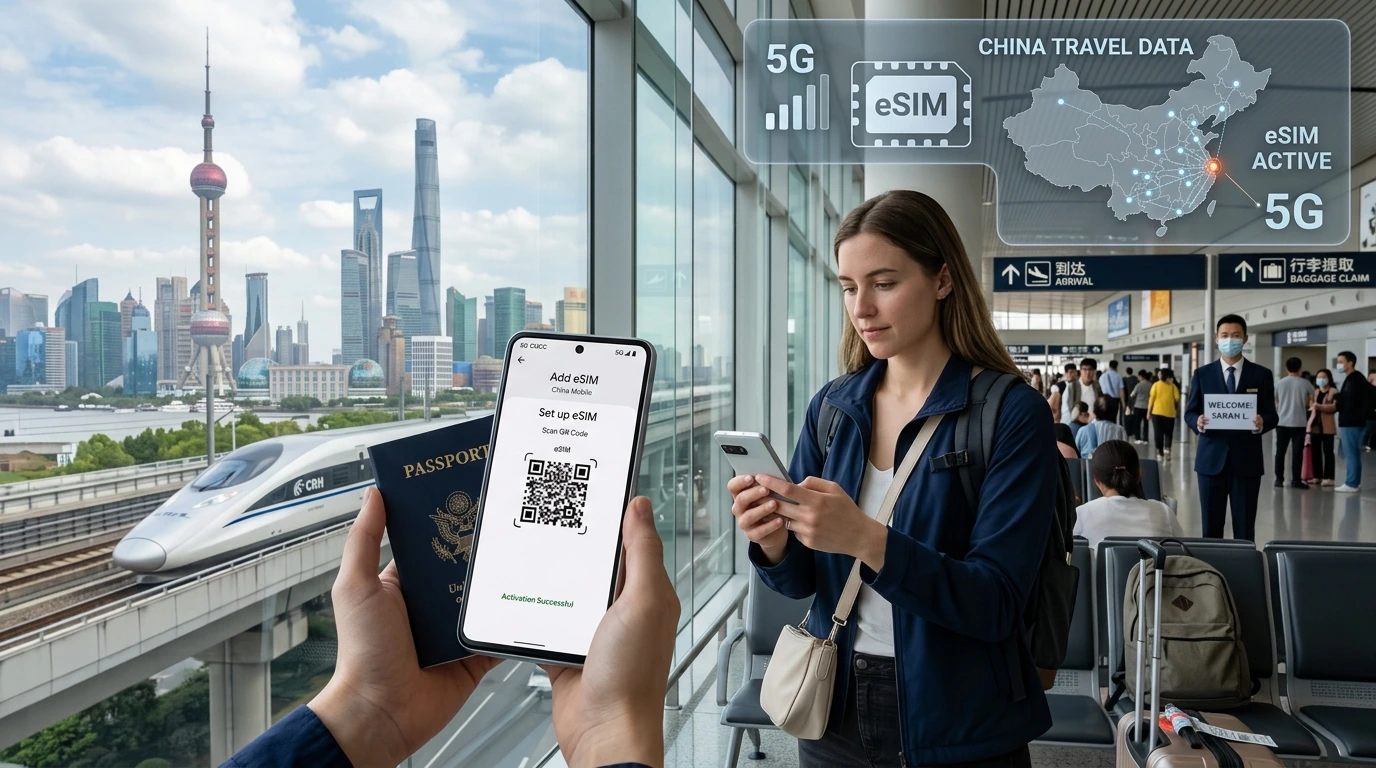
Discover how eSIM technology provides seamless mobile data for your China trip. Learn about activation, device compatibility, and how international eSIMs navigate China's digital landscape for uninterrupted connectivity.
An eSIM provides digital mobile data connectivity for international travelers in China, allowing access to essential online services without a physical SIM card. It works by digitally installing a data plan onto a compatible, unlocked device, typically via a QR code, enabling connection to local networks upon arrival. Crucially, some international travel eSIMs can route data outside mainland China, potentially bypassing local internet restrictions.
Key Takeaways for China eSIM Connectivity
For international visitors planning a trip to China, understanding how eSIM technology works is essential for staying connected. Here’s what travelers should know:
- Digital Convenience: An eSIM is a digital SIM embedded in your phone, eliminating the need for physical card swaps.
- Pre-Trip Setup: You can purchase and install your China eSIM plan before you even leave home, ensuring immediate connectivity upon landing.
- Great Firewall Navigation: Certain international travel eSIMs are designed to route data outside mainland China, which can provide access to global services like Google, WhatsApp, and Instagram without a separate VPN.
- Device Compatibility: Ensure your smartphone is eSIM-compatible and carrier-unlocked before purchasing a plan.
- Activation Timing: While installation can often happen pre-departure, activation (when your plan’s validity period begins) should usually be timed for your arrival in China.
What is an eSIM and How Does it Work for China Travel?
An eSIM, or embedded SIM, is a digital SIM card built directly into your smartphone or other compatible device. Unlike traditional physical SIM cards, an eSIM does not require you to insert or remove a chip. Instead, you purchase an eSIM data plan online, and it is provisioned onto your device digitally, often by scanning a QR code or entering activation details manually.
For international travel to China, this digital functionality offers significant advantages. You can secure your mobile data plan from NexaEsim before your flight, installing it while you still have a reliable internet connection. Once you arrive in China, you simply activate the eSIM, and your phone connects to a supported local mobile network, providing immediate access to mobile data.
eSIM Technology and China's Digital Landscape
Understanding China's unique digital environment is crucial when considering an eSIM. The way your mobile data is routed can significantly impact your online experience.
The Great Firewall Explained
China operates a sophisticated internet censorship system known as the "Great Firewall." This system restricts access to many foreign websites and services that are commonly used internationally. These often include:
- Google Services: Search, Gmail, Maps, Drive, and other Google applications.
- Popular Social Media: Platforms like Facebook, Instagram, X (formerly Twitter), and the international version of TikTok.
- Messaging Apps: Services such as WhatsApp, Telegram, and Line.
- International News: Many foreign news outlets.
Any internet connection routed through a standard local Chinese carrier, whether via a physical SIM or a local eSIM, is subject to these restrictions.
International Travel eSIMs vs. Local SIMs
The key distinction for travelers is not just whether a plan uses eSIM technology, but how the provider manages internet traffic. While local Chinese SIMs and local eSIMs are subject to the Great Firewall, many international travel eSIMs are designed to route data outside mainland China.
This data routing outside China can allow users to access commonly used international services such as Google, WhatsApp, and Instagram without needing a separate Virtual Private Network (VPN). However, this capability varies by provider and specific plan, so it is essential to verify the network configuration and supported services before purchasing.

Ensuring Your Phone is eSIM-Compatible for China
Before purchasing an eSIM for your trip to China, the first step is to confirm that your smartphone supports eSIM technology. Most newer smartphone models, including recent iPhones and many Android devices from manufacturers like Google Pixel and Samsung Galaxy, are eSIM-compatible.
However, compatibility can vary based on:
- Phone Model: Specific models and generations.
- Country or Region of Purchase: Some devices sold in certain regions may have different configurations (e.g., US iPhone 14/15/16 models are eSIM-only).
- Mobile Carrier: Your home carrier's policies may affect eSIM functionality.
- Device Configuration: Ensure your phone is carrier-unlocked, as many international eSIM providers require an unlocked device to function correctly.
If you are unsure, consult your phone manufacturer's specifications or contact your current mobile carrier to confirm eSIM support and unlock status. For more details, you can check whether your phone is unlocked and eSIM-compatible.
The eSIM Activation Process for China
The process of getting your eSIM ready for China is generally straightforward, but timing and attention to detail are important.
Step 1: Choosing a China-Compatible eSIM Plan
Begin by selecting an eSIM plan that explicitly supports China or mainland China. When comparing options from providers like NexaEsim, consider the following criteria:
- Data Allowance: How much data is included?
- Validity Period: How many days is the plan active for?
- Network Coverage: Which local networks does the eSIM use?
- Activation Requirements: Are there any specific steps or timing for activation?
- Hotspot/Tethering Policy: Can you share your data with other devices?
- Customer Support: Is assistance readily available if you encounter issues?
- International Services Access: Does the plan's network routing allow access to services like Google and WhatsApp without a VPN? This is a critical factor for China travel.
Do not base your decision solely on the amount of data; the network arrangement and supported services are equally important for a smooth experience in China. Explore NexaEsim's China eSIM plans to find the best fit for your trip.
Step 2: Understanding Validity and Activation Timing
China travel eSIMs typically have a defined validity period (e.g., 7 days, 15 days). This period usually begins either upon activation or when the eSIM first connects to a supported network in China. Read the provider's terms carefully to understand when your validity period starts.
Step 3: Installing Your eSIM
Your eSIM provider will provide clear instructions for installation. This usually involves one of the following methods:
- Scanning a QR code provided by the provider.
- Manually entering activation information into your phone's settings.
- Installing the eSIM directly through a provider's app or your phone's settings.
It is highly recommended to install your eSIM before leaving home, while you have a stable Wi-Fi or mobile internet connection. This prevents potential difficulties with airport Wi-Fi or connectivity issues upon arrival. However, always double-check your provider's instructions, as some plans should only be activated once you arrive in China.
Setting Up Your Phone for China eSIM Connectivity
Once your eSIM is installed, a few simple steps upon arrival will ensure you get online quickly:
- Turn on Your eSIM Line: Go to your phone's Settings, then Cellular or Mobile Data, and enable your newly installed eSIM line.
- Enable Data Roaming: For most international travel eSIMs, data roaming must be enabled on the eSIM line. This is typically safe and necessary for the eSIM to connect to local networks and route data correctly.
- Set as Mobile Data Line: Designate your China travel eSIM as your primary line for mobile data in your phone's settings.
- Turn Off Roaming for Home SIM: To avoid unexpected charges from your home carrier, ensure data roaming is disabled for your primary physical SIM card.
- Allow Connection Time: Give your phone a few minutes to connect to a supported local network.
- Test Connection: Open a web browser or an app like a map to confirm your internet connection is working.
For a smooth activation process, you can follow a 5-Minute Pre-Flight Checklist before you fly.
Accessing International Apps: Google, WhatsApp, and Social Media
One of the most critical considerations for international travelers in China is access to familiar apps and services. The ability to use Google, WhatsApp, Instagram, and other international platforms depends entirely on the specific eSIM service and its network configuration.
As mentioned, internet access in mainland China is subject to the Great Firewall. However, some international travel eSIMs utilize network arrangements that route your data outside mainland China. This can allow you to access many international services without the need for a separate VPN.
It is crucial not to assume that every China eSIM offers this capability. Before purchasing, always check the provider's current information regarding access to the specific services you need. For example, to understand how travel eSIMs can keep WhatsApp running smoothly without a separate VPN, you can refer to resources like Can You Use WhatsApp in China? and Can Tourists Use Social Media in China?
Mobile Payments in China: Alipay and WeChat Pay with eSIM
Mobile internet is indispensable if you plan to use China's prevalent mobile payment services, Alipay and WeChat Pay. While international visitors can set up these payment options before or during their trip, an active data connection is essential for their daily use.
With a working eSIM providing mobile data, your phone becomes a versatile tool for various travel tasks, including making mobile payments, navigating, translating, and communicating. It's advisable to install and prepare the payment apps you intend to use before your trip, ensuring they are ready to go as soon as you have connectivity.
Estimating Your Data Needs for China Travel
The amount of data you'll need for your China trip depends heavily on your smartphone usage habits:
- Light Data User: If your primary uses are occasional messaging, maps, translation, and checking travel information, a smaller data package (e.g., 1-3 GB for a week) may suffice.
- Moderate Data User: For those who regularly use maps, social media, messaging, mobile payments, travel apps, and web browsing, a mid-range plan (e.g., 5-10 GB for a week or two) is usually more appropriate.
- Heavy Data User: If you frequently stream videos, upload photos, make video calls, use social media extensively, or stream music, you will need a larger data plan (e.g., 15+ GB for a week or more).
Instead of automatically opting for the largest package, estimate your typical daily usage and choose a plan that offers a reasonable amount of data for your expected activities.
eSIM vs. Other Connectivity Options in China
While an eSIM offers significant advantages, it's helpful to compare it with other common ways to get online in China.
eSIM vs. Chinese Physical SIM Card
Both options provide mobile connectivity, but they differ in convenience and features:
| Feature | eSIM | Chinese Physical SIM |
|---|---|---|
| Physical card required | No | Yes |
| Can prepare before arrival | Usually | Usually no |
| Local Chinese number | Depends on plan | Yes |
| Setup convenience | High | Requires SIM purchase/setup |
| Good for short trips | Yes | Yes |
| Good for long stays | Depends on plan | Often useful |
| Requires compatible phone | Yes | Physical SIM slot required |
For short vacations, an eSIM is often more convenient due to pre-trip setup. For longer stays or if a local Chinese phone number is essential, a local physical SIM might be more suitable.
eSIM vs. International Roaming
Using your home mobile provider's international roaming service is another option, but costs can vary significantly.
- eSIM Advantages:
- Often more cost-effective for data than roaming.
- Can be purchased specifically for travel needs.
- Easy to install and use without removing your normal SIM.
- Ideal for short to medium-length trips.
- International Roaming Advantages:
- Keeps your existing phone number active for calls/SMS.
- No separate purchase or installation process if your carrier offers a suitable plan.
- Convenient if your carrier's roaming rates are competitive.
Always check the current international roaming prices from your home carrier before your trip, as they can sometimes be very expensive.
Why Not Rely Solely on Wi-Fi?
While hotel and airport Wi-Fi can be useful, relying solely on it for connectivity in China has limitations. You'll likely need mobile data for critical tasks when you're on the go, such as:
- Navigating after leaving the airport or hotel.
- Contacting your driver or ordering transportation.
- Translating signs or conversations.
- Making mobile payments in shops or restaurants.
- Staying in touch with family and friends while exploring.
Having mobile data available from the moment you land can significantly ease your travel experience, especially for first-time visitors.
Troubleshooting Common eSIM Connection Issues
If your eSIM doesn't connect after you arrive in China, try these troubleshooting steps:
- Toggle Airplane Mode: Turn airplane mode on for about 30 seconds, then turn it off. This can reset your network connection.
- Restart Your Phone: A simple restart can often resolve minor connectivity glitches.
- Confirm eSIM Selection: Double-check your phone's settings to ensure your China eSIM is enabled and selected as the line for mobile data.
- Verify Data Roaming: Confirm that data roaming is enabled specifically for your eSIM line, as per your provider's instructions.
- Manual Network Selection: If automatic network selection fails, try turning it off and manually selecting a supported local network listed in your eSIM plan details.
- Check APN Settings: Ensure the Access Point Name (APN) settings on your eSIM line match those provided by your eSIM carrier.
- Disable Cellular-Data Switching: Turn off any setting that allows your phone to automatically switch between SIMs for data, ensuring it stays on your eSIM.
- Contact Support: If issues persist, connect to Wi-Fi and contact your eSIM provider's customer support for assistance. For important bookings like airport transfers, always have driver and meeting-point information saved offline as a backup. For general setup issues, see What to Do When Your eSIM Doesn’t Work or troubleshooting a slow eSIM.
Avoiding Common China eSIM Mistakes
To ensure a smooth experience, be aware of these common pitfalls:
- Not checking phone compatibility: Always confirm your device supports eSIM and is carrier-unlocked before purchasing.
- Choosing based only on price: The cheapest plan might lack essential features like access to international services or reliable network coverage. Compare network arrangements, validity, and customer support.
- Activating too early: Some plans start their validity period immediately upon activation or first network connection. Read instructions carefully to avoid wasting days of your plan.
- Waiting until you land to set it up: Installing your eSIM before departure, while you have reliable internet, prevents stress and potential issues with airport Wi-Fi.
- Relying on only one communication method: Save important contact and transportation information offline as a backup, especially for airport pickups. Book a private transfer with Hello China Transfer → to ensure a smooth arrival.
Your China eSIM Pre-Departure Checklist
A little preparation goes a long way. Use this checklist before your trip:
- Confirm your phone supports eSIM and is unlocked.
- Purchase a China-compatible eSIM plan from NexaEsim.
- Install the eSIM correctly before you fly.
- Understand the activation instructions and timing.
- Check your mobile data settings for the eSIM.
- Install essential travel apps (maps, translation, payment) beforehand.
- Save hotel and airport transfer information offline.
- Keep driver contact details and meeting points accessible offline.
- Have a backup communication method or plan.
Conclusion
Understanding how eSIM technology works for China travel is key to a seamless and connected journey. An international travel eSIM offers unparalleled convenience, allowing you to secure mobile data before you depart and potentially bypass China's internet restrictions for access to global services. While local SIMs and roaming have their place, an eSIM often provides the best balance of cost-effectiveness, ease of use, and essential connectivity for tourists.
The most important step is to prepare thoroughly before you fly. Confirm your phone's compatibility, choose a plan that meets your data and access needs, and install your eSIM according to the provider's instructions. This proactive approach ensures you'll have reliable mobile data from the moment you land, making your first day in China much smoother. Get a free quote → for airport transfers to complement your connectivity.
Frequently Asked Questions About Using eSIMs in China
Can foreigners buy an eSIM for China?
Yes, international travelers can purchase China-compatible travel eSIM plans from providers that support mainland China. Always check phone compatibility and provider terms before buying.
Can I install a China eSIM before I arrive?
In most cases, yes. It's recommended to install your eSIM before departure while you have a stable internet connection. However, installation and activation can be different; some plans should only be activated upon arrival in China. Always follow your specific eSIM provider's instructions.
Does every China eSIM provide the same internet access?
No. Different providers use various networks and network-routing arrangements. Some international travel eSIMs route data outside mainland China, which can provide access to international services like Google and WhatsApp. Others may behave like a standard mainland connection, subject to local restrictions. Always check the provider's current terms for the services you need.
Do I need a VPN if I use a China eSIM?
It depends on the eSIM and its network configuration. Some international travel eSIMs are designed to route data outside mainland China, potentially allowing access to international services without a separate VPN. If your eSIM does not offer this, or if you need access to specific services, a VPN may still be useful. For more information, see Do You Need a VPN for Travel to China?
Can I keep my normal SIM card while using a China eSIM?
Many compatible smartphones allow you to use a physical SIM and an eSIM simultaneously. This enables you to keep your home SIM active for calls or SMS while using the travel eSIM for mobile data. Your exact options depend on your phone model and carrier.
What if my eSIM doesn't work after I land?
First, recheck your eSIM installation, ensure it's selected for mobile data, and verify that data roaming is enabled on the eSIM line. Try toggling airplane mode or restarting your phone. If issues persist, contact your eSIM provider's customer support. For critical information like airport transfers, always have details saved offline as a backup.